
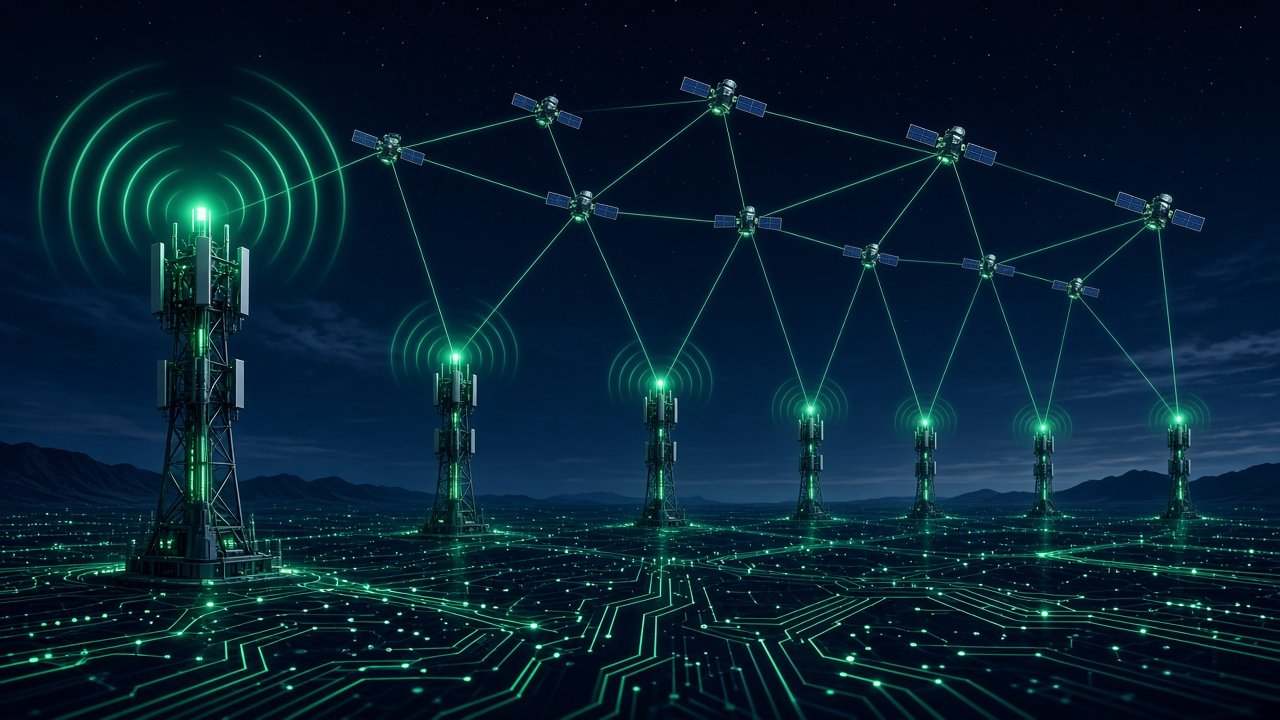
Qualcomm calls it its biggest 5G deal yet. For Verizon, AT&T and T-Mobile, it's the clearest sign so far that SpaceX plans to compete on the ground, not just from orbit.
By Methodical Jon | Nov 4, 2026
SpaceX has picked Qualcomm (NASDAQ: QCOM) to supply the core technology for Starlink Mobile's planned nationwide 5G network in the U.S. Qualcomm announced the multiyear agreement on Wednesday and said the rollout is planned to start in 2027, with tens of thousands of sites deployed over the life of the deal. Financial terms weren't disclosed, but Qualcomm told Reuters that "this is our biggest 5G deal yet."
What happened
Starlink Mobile's ground network will run on Qualcomm's Dragonwing cellular infrastructure platforms. Qualcomm is supplying the QRU100 and QDU100 platforms, which handle processing inside the radio units and the baseband units, along with its commercial-grade Layer 1 software. That software is the foundational radio layer of a cell network.
The radios will use Massive MIMO with 64 transmit and 64 receive paths (64T64R), a setup Qualcomm says is designed to improve coverage, capacity and spectral efficiency. Spectral efficiency means how much data you can push through a given slice of airwaves.
Qualcomm executive Durga Malladi told Fierce Network that the sites will all be macro cells, not small cells. He also said Massive MIMO is usually deployed in bands of 3.5 GHz and above, while SpaceX plans to use it down at 2 GHz. Deployment starts next year and is "going to ramp up pretty rapidly from there onwards," he said.
Qualcomm said in its statement that the network will "complement Starlink's satellite capabilities," CNBC reported. Malladi framed it as a step toward something bigger: "Together with SpaceX, we are building world-leading cellular infrastructure in the United States, advancing 5G today, with an opportunity to lay the foundation for AI-native 6G in the years ahead."
Context: a satellite company building towers
Starlink is SpaceX's money machine. According to CNBC, it made up 36% of SpaceX's revenue in the third quarter and 85% of its operating profit. Satellites alone can't match the voice, video and data coverage phones get from the big carriers, though, so SpaceX has spent the fall assembling the pieces of a full mobile network:
- Spectrum: On October 8th, SpaceX agreed to buy Grain Management's nationwide 800 MHz portfolio, which Grain said is still subject to FCC approval. The market reaction was brutal. CNBC reported that Verizon fell 8.75% the next day, its worst day since 2002, while T-Mobile dropped 13.27% and AT&T 9.81%.
- Customers: CNBC also notes the Washington Post reported earlier this week that SpaceX is in talks to acquire EchoStar's Boost Mobile.
- Gear: Now there's Qualcomm. It joins a customer list that already includes Verizon, Dish and Vodafone on the infrastructure side, according to CNBC.
There are still big gaps. SpaceX hasn't named any tower partners or said how many new towers it might need, CNBC reported. Carriers typically lease space from tower owners like American Tower (NYSE: AMT) and Crown Castle (NYSE: CCI).
Why it matters
For Qualcomm, this is a diversification story. The company is best known for the modems inside phones, and Reuters notes the deal pushes it further into cell-tower chips, where it competes with Marvell, Broadcom and Intel. A high-profile carrier-scale win makes that pitch easier to sell to everyone else.
For the incumbents, it changes the question. When the spectrum deal landed in October, JPMorgan analysts saw "limited near-term risk" to the big three, citing "the time, infrastructure and capital required to build a competitive terrestrial network," according to CNBC. Today's deal starts to answer the infrastructure part. Time and capital are still the open questions. Reuters also flagged that doubts remain about whether SpaceX's plan is feasible, given how much investment it takes to compete with the big three.
For SpaceX, it's vertical ambition with a public-market price tag. The company went public in June in the largest IPO on record and is valued at close to $2 trillion, per CNBC. Investors are paying for Starlink growth, and a ground network is how Starlink goes from home internet and backup texting to being the main plan on your phone.
What to watch next
Watch the FCC's review of the 800 MHz purchase, any tower-company deals (which would show how fast those tens of thousands of sites can actually go up), whether the Boost Mobile talks turn into a deal, and how much this ground buildout adds to SpaceX's capital spending. Also watch what the carriers do on pricing. That will be the first real sign of whether they see this as a threat or a sideshow.
The money lesson
1. Moats get crossed in pieces. Spectrum, then gear, then towers, then customers. Each step looks small on its own, but together they add up to a new competitor. Track the sequence, not the single headline.
2. Sell shovels to the challenger. Qualcomm doesn't need Starlink Mobile to win to get paid. Suppliers to an industry fight often have the cleaner business.
3. "Terms not disclosed" is information too. "Biggest 5G deal yet" with no dollar figure tells you it's important, but not how important. Don't fill in the number yourself.
4. Profit centers fund new bets. Starlink earns 85% of SpaceX's operating profit, per CNBC. When a company's best business starts funding a bold expansion, watch the margins of that core business.
We talked about where technology is heading in Episode 57 - Tech of the Future. A rocket company using a phone-chip maker's gear to build a cell network is exactly the kind of convergence that episode is about.
At the time of writing, financial terms of the Qualcomm agreement had not been disclosed, the 800 MHz spectrum purchase was still awaiting FCC approval, and SpaceX had not responded to CNBC's request for more information. This article is for informational purposes only and is not financial advice.
Sources:
- Qualcomm via Business Wire, "SpaceX Selects Qualcomm to Accelerate Starlink Mobile's Nationwide 5G Network" (Nov 4, 2026): https://www.businesswire.com/news/home/20261104680757/en/SpaceX-Selects-Qualcomm-to-Accelerate-Starlink-Mobiles-Nationwide-5G-Network
- CNBC, "SpaceX signs deal with Qualcomm to provide network technology for U.S. mobile service" (Nov 4, 2026): https://www.cnbc.com/2026/11/04/spacex-strikes-deal-with-qualcomm-for-mobile-network-infrastructure.html
- Reuters (via Investing.com), "Qualcomm signs major 5G infrastructure deal with SpaceX for Starlink Mobile network" (Nov 4, 2026): https://www.investing.com/news/stock-market-news/qualcomm-signs-major-5g-infrastructure-deal-with-spacex-for-starlink-mobile-network-4999443
- Fierce Network, "SpaceX's nationwide terrestrial 5G plans get real as Qualcomm signs on" (Nov 4, 2026): https://www.fierce-network.com/wireless/spacexs-nationwide-terrestrial-5g-plans-get-real-qualcomm-signs
- CNBC, "Verizon posts worst day since 2002 as SpaceX U.S. network plans whack cell provider stocks" (Oct 9, 2026): https://www.cnbc.com/2026/10/09/verizon-att-tmobile-stocks-spacex-network.html
- Grain Management, "Grain Management Announces Definitive Agreement to Sell Nationwide 800 MHz Spectrum Portfolio to SpaceX" (Oct 8, 2026): https://graingp.com/grain-management-announces-definitive-agreement-to-sell-nationwide-800-mhz-spectrum-portfolio-to-spacex/
Thanks for reading another Methodical Minute. To read more just like this, please subscribe below and share with someone you know.
This article may be AI-assisted and is subject to errors and omissions.