
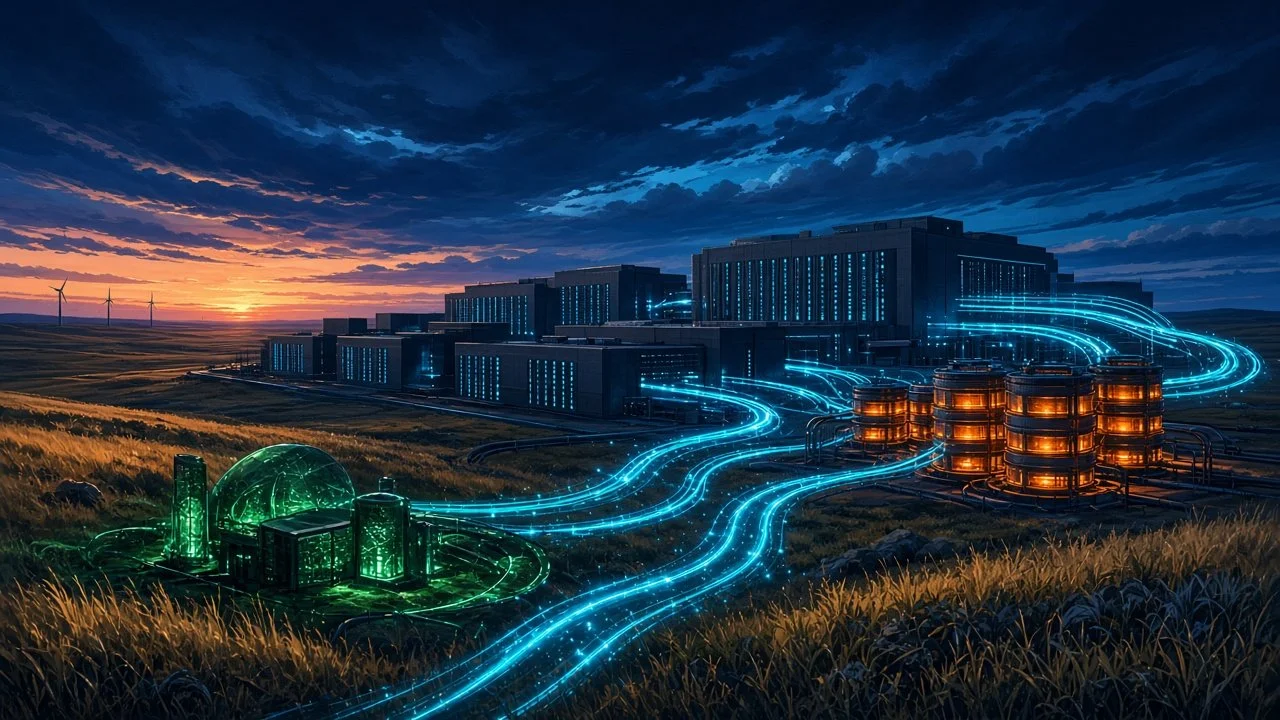
Alphabet is putting a price tag on its first Cowboy State campus — and pairing it with a 702-megawatt fuel-cell plant — just as midterm ballot fights turned data centers into a national political risk.
By Methodical Jon | Nov 6, 2026
Alphabet's Google (NASDAQ: GOOGL) said Thursday, November 5th 2026, that it will invest $17 billion USD to build its first data center in Wyoming, according to the company's blog and a Reuters report. The campus is planned for Laramie County near Cheyenne, in partnership with Tallgrass Energy, Black Hills Energy, American Electric Power (NASDAQ: AEP) and Related Digital.
The timing is the story. Of 41 data center-related ballot measures voted on in the midterms, all but one went against data centers, Ballotpedia data cited by Reuters and CNBC. Google is answering that backlash with a big check, a friendly state, and a public promise to pay for its own power.
What happened
Google framed the project as a long-term bet on Wyoming jobs, infrastructure and energy. Key commitments from the company post:
- $17 billion USD total investment in the state
- Power paid at 100% of what Google uses, including infrastructure driven by its growth
- An air-cooled design to cut local water strain
- A Community Council with partners to handle Cheyenne growth concerns
- Education and workforce grants tied to STEM and skilled trades
The power plan is the technical headline. Google contracted with AEP for what it calls a first-of-its-kind commercial-scale 702 MW fuel-cell development with carbon capture and storage (CCS). Fuel cells will come from Bloom Energy (NYSE: BE). Captured carbon is slated for permanent geologic storage at Tallgrass's Eastern Wyoming Sequestration Hub. Google said the project lifts its total contracted CCS capacity to nearly 1 gigawatt.
AEP said earlier that it plans to invest about $4 billion USD in the Cheyenne fuel-cell project under a 20-year power purchase agreement with Google, with the facility expected to be fully operational by the end of 2028, per AEP's Oct. 14 release. Cheyenne Fuel Cell, LLC is about 92% owned by AEP.
Context
Wins by data-center skeptics in Texas and Georgia helped spook AI infrastructure stocks this week — a risk we covered when Texas voters elevated a moratorium message. Wyoming is a different map: a Republican stronghold where Donald Trump won more than 70% of the 2024 presidential vote, Reuters noted.
Peers are adjusting. Bloomberg, via Reuters, reported Microsoft declined to expand a Texas deal with AI cloud provider Nscale and planned tighter oversight of some neocloud projects from Nebius, IREN and Nscale. Bloom Energy shares slumped more than 14% on restriction fears. Separately, OpenAI published commitments to drop most NDAs with public officials on future company-owned data centers, solicit community input, publish construction plans and keep paying the full cost of power.
The buildout is still on. The playbook is shifting from quiet land deals to public charm offensives and friendlier jurisdictions.
Why it matters
A $17 billion USD campus says hyperscalers will keep spending even after a midterm that priced political risk into AI stocks. The bottleneck has moved: chips still matter, but power, water, local taxes and voter consent now sit on the critical path.
Google's package — pay for power, air cooling, CCS, a community council — answers the complaints that lost 40 of 41 ballot fights. Whether that template spreads will decide how fast the next wave of campuses gets built outside safe states.
The money lesson
1. Jurisdiction is a capital-allocation decision. Google put $17 billion USD into a state that still wants the project. Treat political geography like rent: price it before you sign.
2. Pay for your own power, or risk owning the bill anyway. Google's "100% of the power we use" line and OpenAI's similar pledge are risk management after voters linked AI campuses to higher utility bills.
3. Community buy-in is now infrastructure. A Community Council will not replace a power plant, but it can keep a $17 billion USD plan from dying in a town hall.
4. Energy tech is part of the AI trade. A 702 MW fuel-cell + CCS stack means Bloom, AEP and sequestration partners are downstream bets on the same buildout — and just as exposed when politics turns.
For how companies decide where scarce capital goes when the map changes, listen to Episode 33 - Capital Allocation. A $17 billion USD Wyoming bet is capital allocation under political constraint.
At the time of writing (~12:15 p.m. ET Friday, Nov 6, 2026), Alphabet was trading near the high-$280s USD after a volatile AI week; prices move. This article is for informational purposes only and is not financial advice.
Sources:
- Google blog, "Investing in Wyoming's infrastructure, energy and workforce" (Nov 5, 2026): https://blog.google/innovation-and-ai/infrastructure-and-cloud/global-network/wyoming-data-center/
- Reuters via Yahoo Finance (Nov 5, 2026): https://finance.yahoo.com/technology/ai/articles/google-plans-17-billion-wyoming-204551123.html
- AEP news release (Oct 14, 2026): https://www.aep.com/news/stories/view/12314/
- CNBC on OpenAI data-center commitments (Nov 5, 2026): https://www.cnbc.com/2026/11/05/openai-to-pay-for-data-center-power-after-election-shows-ai-concern.html
- Prior MM coverage: https://www.methodicalmillions.com/read/texas-27-percent-data-centers-moratorium-ai-stocks
Thanks for reading another Methodical Minute. To read more just like this, please subscribe below and share with someone you know.
This article may be AI-assisted and is subject to errors and omissions.